

At the height of fertility, chickens lay around three hundred eggs per year. While we appreciate their contribution to our plates, knowing that hens lay almost every day leads us to wonder, does it hurt chickens to lay eggs?
Does It Hurt Chickens To Lay Eggs?
To fully understand if chickens feel pain when laying eggs, it is helpful to have some insight into the process of egg formation within the hen. Let us look at how egg formation works for chickens.
Egg Formation For Chickens
When hatching, hens have countless immature egg yolks already within their ovaries. When they are mature (this can be between sixteen weeks and sixteen months old, depending on the breed), light entering their eyes affects their pineal gland and begins the process of releasing an egg. (source)
The immature egg yolk is released and journeys along the hen’s reproductive system until it spends around twenty hours developing a thick, strong shell designed to protect the internal parts of the egg from bacteria and other harmful agents.
For many chickens, the sensation of forming an egg often triggers them to begin building or adding to a nest. They can often be observed working on their nest and then perching on top of it before laying the egg inside it.
Laying The Eggs
Chickens know when they are about to lay an egg. When the time is approaching, they prepare a comfortable spot for themselves. They may distance themselves from the other chickens in the coop and spend some time straining a little or even squawking.
The process of laying is relatively quick compared to a mammal giving birth. The average time for a hen to lay an egg is one and a half minutes. Of course, it could take a little longer or shorter, depending on the specific circumstances.
Circumstances could include the egg’s size and the chicken’s age. Younger chickens that are not experienced in egg laying take longer to lay than mature hens who are used to the process.
Eggs are laid from the cloaca of the hen. This hole is used for urinating, defecating, and laying eggs. Chickens focus on the task and work efficiently to ensure the egg is released.
From time to time, eggs that are too large for the chicken, or are a strange shape, get stuck inside. This phenomenon is called egg binding. When this happens, it causes distress, pain, and even death in some cases. If your hen experiences egg binding, you will need to intervene to ensure her safety.
Is It Hard For Chickens To Lay Eggs?
Although it is not entirely pleasant, it is not extremely hard for chickens to lay eggs. The process can be challenging for young chickens to lay eggs for the first time. Laying takes a little longer for young hens, and they sometimes squawk from discomfort.
The entire egg formation takes more than twenty hours, and it is only the last minute or two that may be difficult. Chickens make themselves comfortable for the event and focus on laying.
The part that may be hard is when the cloaca stretches to allow the shape of the egg to exit the body. Again, it is more difficult for younger hens, and the process seems to become more manageable after their first time.
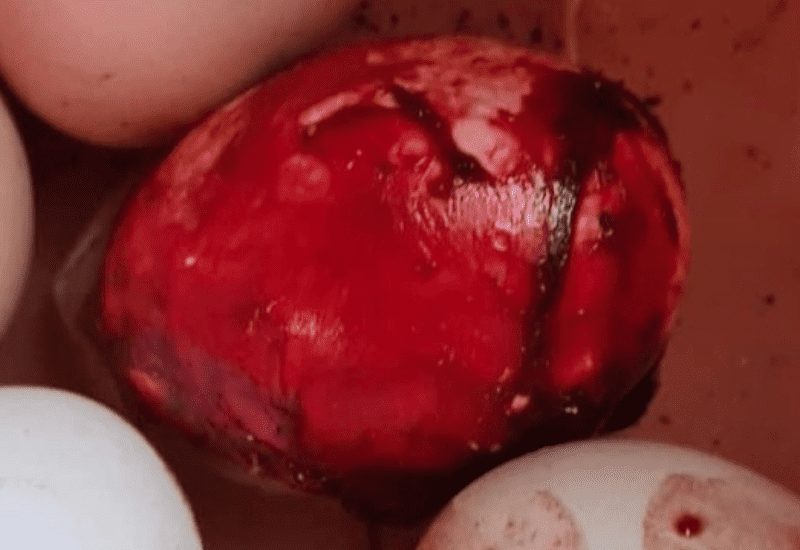
When chickens experience difficulty laying an enormous or jumbo egg, it is common to see blood spots on the egg and on their stools for a while afterward.
How Painful Is It For A Chicken To Lay An Egg?
Chickens possess a central nervous system, brain, and nerves. (source) It is believed they can feel pain and stress much the same way as humans and other mammals.
Still, laying an egg is less painful than when a mammal gives birth to a baby. The process is much quicker, and chickens appear to settle soon after laying, indicating that, in general, the event does not cause much damage or pain.
When a chicken lays an egg, the bird’s cloaca stretches to accommodate the exit. This is the part that is potentially painful for a chicken.
For young chickens, particularly those laying for the first time, the experience can be rather painful, and they may squawk while laying their eggs. With these hens, there may be blood on the egg, revealing that the process was likely painful.
In addition to finding blood on the egg, you will likely see blood in their stools for a day or so as they heal from the laying experience. It is fair to assume that hens feel pain for a short while after laying their first egg.
After their first laying experience, chickens appear to become more at ease with the process. Indeed, you will seldom see blood on the eggs of a more experienced hen, unless the egg was particularly large.
Does It Hurt Chickens To Lay Large Eggs?
Through selective breeding and special diets, chickens can create jumbo eggs. In most cases, these large eggs are not a good match for the chicken expected to lay them. Blood stains can often be spotted on jumbo eggs, leading us to believe that it often does hurt chickens to lay large eggs.
The British Free Rand Producers’ Association chairman has stated publicly that he believes chickens experience pain and stress when laying large eggs. (source) Other public figures have denounced the purchase of jumbo eggs since they believe the practice to be cruel toward the hens laying them.
Even for free-range chickens, eggs can sometimes become larger than expected. Sometimes, this is because an egg contains two yolks. In these instances, you will notice the chicken gasping and wheezing while laying the egg, and the chicken will likely bleed.
How Do You Know When Chickens Are About To Lay Eggs?
There are a few signs to look out for when considering if your chicken is about to lay eggs. Determining if your hen is mature enough to begin laying is essential. Once you have decided she is, watch out for behavioral signals before the egg arrives.
Let us look at a few signs that will help you determine if your chicken is mature enough to lay eggs:
- The hen is as large as other adult hens in the coop.
- The hen has developed a solid bone structure, similar to others in the enclosure.
- The hen has become larger in the abdomen area.
- You notice the hen’s wattle and comb become larger and bright red in color.
- The hen’s cloaca becomes larger than before, red and possibly moist.
- When picking the hen up, you feel a distance between the pelvic bones under the chicken.
Once you are sure your chicken is mature and ready to lay eggs, you may wish to look out for behavioral signs that she is about to lay. After the first lay, chickens tend to lay almost every day, and you will soon get to know the unique behavior your chicken displays just before she lays.
Some typical behaviors include:
- Nesting. You can soon expect an egg when your hen begins rearranging bedding materials in the nesting area. If your chickens are entirely free-range, look out for when your chicken selects a private spot and starts creating a comfortable nest for herself.
- Perching. Hens can feel the process of the egg forming inside their bodies. If you notice your hen perching on top of her nesting box and squawking a little more than usual, it could mean an egg is on its way.
- Straining. You may notice a little straining or effort when hens are perched. (source)
Chickens typically socialize in groups. If you notice your chicken taking some time alone, working on a nest for herself, and keeping to herself, it could mean she is about to lay an egg.
Although hens perch on top of their nesting boxes before laying, they typically lay the egg inside the nest. The first few eggs may not look like the usual oval we are accustomed to. The shape and color will settle after a while as the chicken’s body becomes attuned to the process.
Conclusion
It is not typically excruciating for chickens to lay eggs. If the chicken is laying for the first or second time, or the egg is particularly large, laying can hurt the chicken. Although chickens have similar pain sensations to mammals, laying eggs does not typically hurt them like giving birth hurts mammals.
When your chicken shows signs of being mature enough to lay, look out for changes in their behavior to signify that they are about to lay an egg. The chicken will likely create a comfortable nest, perch on top of the nesting box, and detach from the other chickens for a while. If your chicken shows signs of being egg-bound, intervene to avoid excessive pain and even death.

David Cameron is a passionate chicken enthusiast. Growing up, he always wanted to be a veterinarian and loved animals. After graduating from veterinary school, David spent over 40 years as an equine veterinarian. He and his wife retired a few years ago and moved to North Carolina. Here, David’s love of chickens grew even more – he now has 7 chickens and 6 quail. If you have any questions about chickens, feel free to reach out.